
By Harold D. Stolovitch & Erica J. Keeps
hstolovitch@hsa-lps.com & ekeeps@hsa-lps.com
 This
article discusses both the emergence and re-emergence of "human capital"
and considers Human Performance Technology (HPT) and the HPT professional's
relation to it.
This
article discusses both the emergence and re-emergence of "human capital"
and considers Human Performance Technology (HPT) and the HPT professional's
relation to it.
Theodore Schultz in 1979 and Gary Becker in 1992 both won Nobel prizes in economics for their work in human capital. There was a brief period of excitement for this new concept in the early 1980's that quickly faded. However, in the last ten years, the human capital theme has once again emerged as a serious and strategic business issue. A number of authors such as Davenport (1999), Edvinsson and Malone (1997), Fitz-enz (2000), Kravetz (2004), Pfeffer (1998) and Stewart (1997) have fanned the flames of human capital accounting and potential and have demonstrated the high returns to be derived from human capital management.
By human capital we mean the sum total of all knowledge, experience and performance capability an organization possesses that can be applied to create wealth. The key words are performance capability. This is HPT's purview. The HPT professional is above all a leverager of human capital. What follows are brief statements of HPT's key mission, process, roles and context for application.
The key mission of HPT: the leveraging of human capital in the most efficient manner to achieve targeted, valued results.
The key process of HPT: the engineering of valued and effective individual and organizational performance based on systemic, systematic and scientific principles and demonstrated through credible measures.
The key roles of the HPT professional: analyst, consultant, designer, evaluator, facilitator, project manager, management mentor and, as required, organizational therapist.
The key contexts of HPT application: the workplace or work setting. However, increasingly, HPT is being applied in social settings (e.g. reproductive health in developing nations; community substance abuse programs; public education; improved quality of life for the chronically ill aged).
As you can see, there is a direct relationship between human capital, the field of HPT and the work of the HPT professional.
References
Davenport, T.B. (1999). Human Capital: what it is and why people invest in it. San Francisco, CA: Jossey-Bass.
Edvinsson, L. and Malone, M.S. (1997). Intellectual capital: realizing your company's true value by finding its hidden brainpower. New York, NY: HarperCollins Publishers.
Fitz-enz, J. (2000). The ROI of human capital: measuring the economic value of employee performance. New York, NY: American Management Association.
Kravetz, D.J. (2004). Measuring human capital: converting workplace behavior into dollars. Mesa, AZ: Kravetz Asociates Publishing.
Pfeffer, J. (1998). The human equation: building profits by putting people first. Boston, MA: Harvard Business School press.
Stewart, T.A. (1997).
Intellectual capital: the new wealth of nations. New York, NY:
Doubleday/Currency.

 Workforce
Performance Solutions is
a bi-monthly magazine directed to top-level management, senior human resources,
and workforce and organizational development executives whose task is
to optimize the abilities of their human assets to drive and improve the
execution of enterprise strategy. Harold Stolovitch is the regular "Human
Performance" columnist for Workforce Performance Solutions
magazine. You can read his latest article, "Three Performance Principles
to Keep You on Target" by
visiting page 16 of the September 2006 digtial edition at http://www.wpsmag.com/digital0906.
For more information on Workforce Performance Solutions, visit
their Website at www.wpsmag.com.
If you have any topics that you would like to see Harold address in his
column, please email him at hstolovitch@hsa-lps.com.
Workforce
Performance Solutions is
a bi-monthly magazine directed to top-level management, senior human resources,
and workforce and organizational development executives whose task is
to optimize the abilities of their human assets to drive and improve the
execution of enterprise strategy. Harold Stolovitch is the regular "Human
Performance" columnist for Workforce Performance Solutions
magazine. You can read his latest article, "Three Performance Principles
to Keep You on Target" by
visiting page 16 of the September 2006 digtial edition at http://www.wpsmag.com/digital0906.
For more information on Workforce Performance Solutions, visit
their Website at www.wpsmag.com.
If you have any topics that you would like to see Harold address in his
column, please email him at hstolovitch@hsa-lps.com.

Our Guest Author Series
features interesting articles by various professional colleagues. The
latest in our series is by Jim and Dana Robinson. They are the principals
of Partners in Change, a firm they founded in 1981, based in Pittsburgh,
Pennsylvania. The Robinsons have co-authored five books, including Performance
Consulting (1995) and Strategic
Business Partner (2005). They can be reached at mail@partners-in-change.com.
Their Website is www.partners-in-change.com.
Strategic Business Partner and Performance Consultant: Two Important Roles, Some Important Differences
By Dana Gaines Robinson and Jim Robinson
 "Project
managers in our Information Systems group are missing deadlines and running
over budgets we have established for these projects. I would like to provide
them with some project management skill training; we may also want to
look at re-engineering the project management process we use."
"Project
managers in our Information Systems group are missing deadlines and running
over budgets we have established for these projects. I would like to provide
them with some project management skill training; we may also want to
look at re-engineering the project management process we use."
"Our business has been losing market share for our signature brands in the past three years. Clearly we need to take some actions that will help get our business, as well as our employees and managers, back on track. Let's discuss what actions we need to take."
Which of these requests would a performance consultant typically manage, and which request would a strategic business partner normally address? We will answer that question in this article, but first let's discuss each of these roles in more detail. And, note that we are using the term "role," not "job." Within any job, people fill many roles…some describe this as wearing many hats. The two roles we focus upon in this article are performance consultant and strategic business partner. There are people who work in both of these roles; other individuals only fill one of them. The two roles share much in common but also have key differences. Let's begin by examining how these roles are similar.
Similarities Between Roles
People who work in the role of performance consultant and the role of strategic business partner…
- Utilize Human Performance Technology Principles: They examine situations from a systematic and holistic perspective, identifying performance gaps and their causes.
- Focus on Results, Not Solutions: Individuals in both roles view the solutions they offer as means to an end, not the end itself. A solution would be that individuals develop skills; the result is that those individuals apply the skills in the workplace and contribute to business results.
- Initially Use a Solution and Cause Neutral Approach: Individuals in either role realize that jumping to solutions is a quick way to achieve failure. We have found this to be one of the most difficult skills for performance consultants and strategic business partners to master. Business environments typically encourage quick solutions and immediate action. Many of us who work in these roles have been conditioned to solve problems, sometimes before we have determined what the problem is.
- Partner with Clients: While performance consultants and strategic business partners can affect the capability of employees within the organization through learning and HR solutions, this is only half of the solution. The other half is the work environment and infrastructure. For example, are roles and expectations clarified? Do people have access to coaching and reinforcement as they perform their jobs? Managers control these factors. It is they who own the business and whose performance needs are being supported. They are also in the chain of command of the individuals whose performance requires change. Therefore, both performance consultants and strategic business partners must build and deepen partnerships with manager-clients and work collaboratively with them to achieve results.
- Manage, Not Deliver, Solutions: Both performance consultants and strategic business partners must be adept at project management. They become orchestrators of solutions needed to address a specific business or work group. They identify the "experts" in solution design and delivery. As there is a myriad of possible solutions that may be needed for any given situation, it is not possible for one individual to have all the required expertise. It is also difficult to have the time needed to build relationships and analyze situations when time is taken to design and deliver solutions. For all these reasons, people in either role most appropriately manage, not deliver, solutions.
The Differences Between Roles
There are five ways in which the roles of the performance consultant and strategic business partner are different.
- Scope
of Work: When working as a performance consultant, the goal
is to partner with clients to enhance the performance of people in one
or more work groups, ensuring that their performance supports business
goals. Strategic business partners focus on enhancing capacity of organizations
(such as a business unit, division, major function or the entire enterprise)
to achieve business results. This is a larger focus that will encompass
addressing needs of multiple work groups. It also frequently requires
addressing organizational design issues.
- Depth and Type of Client Partnerships: Developing effective partnerships with clients and growing personal knowledge of the "business of the business" of clients are accountabilities for individuals in both roles. We use the term client to mean the person or persons responsible for achieving the business results supported by the initiative. Strategic business partners frequently form partnerships with senior leaders within the organization, maintaining these partnerships on a sustained and ongoing basis. Performance consultants are more likely to develop project-based partnerships with individuals at any managerial level within the organization. An implication of this difference means that those who work in the role of strategic business partner must have a very deep knowledge of the business of the clients' business. We often indicate that a strategic business partner is someone who is a business person specializing in the human side of business.
- Solutions Utilized: A performance consultant most often oversees and manages implementation of solutions that are provided by that consultant's function. For example, performance consultants who work within a corporate university or global learning center typically offer a variety of learning and development solutions including coaching, mentoring, formal training and job aids. By contrast, strategic business partners broker solutions from any function within the organization as well as from external suppliers.
- Timeframe of Work: Certainly the scope of the project has an impact upon the timeframe of work. Performance consultants, working on initiatives that enhance performance of work groups, generally are involved in projects that focus on a timeframe of 12 months or less. Strategic business partners, focusing on initiatives that result in organizational change, are involved in projects that have a one to five year window.
- Organizational
Position: Performance consultants are usually located in
the learning and performance function of an organization (i.e. global
learning center or corporate university) while strategic business partners
are most frequently within the human resources organization. In our
experience, those individuals who have worked in the role of HR Generalist
are frequently transitioning into the strategic business partner role,
forming a single point of contact for their clients.
So, What's the Answer to Our Question?
The bottom line is that both roles are critical if organizations are to be successful. Because of both the similarities and differences we have noted, the roles can be very synergistic. And the answer to the question we raised at the start of this article? The first example, entering as a request for a learning solution, would most likely be managed by a performance consultant; the second situation, coming with no pre-defined solution and with a clear link to a business need, would most likely be the responsibility of a strategic business partner to manage. All we can say is vive la difference!
We're
always looking for great articles to include in our Guest Author Series.
If you have one that you would like us to consider, please contact
Erica Keeps at ekeeps@hsa-lps.com.

 Due
to popular demand, Harold will be the principal speaker and facilitator
at ASTD's Telling Ain't Training Mini-Conference on October 16 & 17
in Orlando, FL. Click here
Due
to popular demand, Harold will be the principal speaker and facilitator
at ASTD's Telling Ain't Training Mini-Conference on October 16 & 17
in Orlando, FL. Click here
 for
more information. He will also lead ASTD's Training Ain't Performance
Mini-Conference on October 18 & 19 in Orlando, FL. Click here
for more information. Space is limited so reserve your spot today!
for
more information. He will also lead ASTD's Training Ain't Performance
Mini-Conference on October 18 & 19 in Orlando, FL. Click here
for more information. Space is limited so reserve your spot today!
Harold Stolovitch will be presenting at the International Society for Performance Improvement's (ISPI) Greater Los Angeles Chapter on October 28 in Los Angeles, CA and at the Canadian Society for Training and Development's (CSTD) annual conference on November 6 & 7 in Toronto, ON. Click here to view HSA's Events Calendar to learn where and when Harold will be speaking as well as to read session descriptions.

 Do
you have any burning human performance technology questions? Visit the
Ask Harold section of HSA's Website
and ask your questions for Harold Stolovitch to answer. Here is a recent
submission that might intrigue you:
Do
you have any burning human performance technology questions? Visit the
Ask Harold section of HSA's Website
and ask your questions for Harold Stolovitch to answer. Here is a recent
submission that might intrigue you:
In which types of companies are technical skills more important than human relations or conceptual skills for their top managers?
To read the response, visit Ask Harold. To ask your own question, just click on the crystal ball above, fill out the form and click submit.

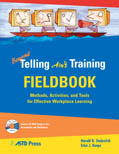
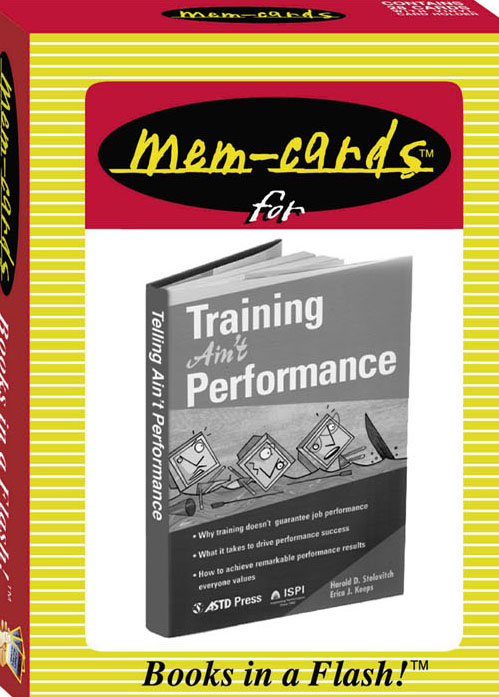
Click on any of the covers below for more information or to buy copies of our books and learning aids.





For more information on HSA, visit our Website
at www.hsa-lps.com, email us at info@hsa-lps.com
or call us toll free at (888) 834-9928.If you have any questions or comments, please feel free to contact Samantha Greenhill, Publications and Communications Specialist, at sgreenhill@hsa-lps.com.

To unsubscribe from this Newswire, please reply to this email and put the word UNSUBSCRIBE in the subject line.
© Copyright 2006 Harold D. Stolovitch & Erica J. Keeps