
By Harold D. Stolovitch & Erica J. Keeps
hstolovitch@hsa-lps.com & ekeeps@hsa-lps.com
 Making
performance improvement happen depends on your competencies, characteristics
and consulting capabilities. Nevertheless, clients also have an important
role to play. You can help them fulfill it. There are times when you are
an extra pair of hands, just helping out your client by doing what she
or he asks for. There may be other times when the client disappears, and
you seem to have taken over, doing everything without him or her. While
these happen from time to time, they mustn't occur too often. The ideal
state of partnership for performance success is a collaborative one with
shared responsibilities and duties.
Making
performance improvement happen depends on your competencies, characteristics
and consulting capabilities. Nevertheless, clients also have an important
role to play. You can help them fulfill it. There are times when you are
an extra pair of hands, just helping out your client by doing what she
or he asks for. There may be other times when the client disappears, and
you seem to have taken over, doing everything without him or her. While
these happen from time to time, they mustn't occur too often. The ideal
state of partnership for performance success is a collaborative one with
shared responsibilities and duties.
The table that follows outlines client responsibilities for ensuring a performance improvement project's success and what you can do to make sure your client engages in each of these. As you examine the table, imagine you are involved in a large-scale performance improvement project that includes not only you as the key performance consultant player, but also a team of internal and external resources.
Smaller-scale projects are not quite as demanding. Nevertheless, the principles embedded in the table apply. Clients must, at a minimum, still approve, provide resources, monitor progress and results, and reward/reinforce. Your job remains one of being there to assist and facilitate as appropriate.
Client Responsibilities and Ways You Can Assist
|
Client
Responsibilities
|
Ways
You Can Assist
|
| Approve analysis, selection, design/development and implementation outputs (intermediate and final) |
|
| Provide resources |
|
| Support performance improvement team |
|
| Facilitate payments |
|
| Contract |
|
| Monitor progress and results |
|
| Reward/reinforce |
|
Your mission is business success through people performance. Your role is that of the partner consultant. Your job is to:
- Inform clients and stakeholders of what performance consulting is and is not (e.g., just training). To be successful, you must explain the roles and services they should expect from you. To do this, you will have to provide concrete examples.
- Show samples of
what you and your learning and performance support team have done for
other internal clients. Create and foster appropriate expectations as
you transform from order-taker to the new, expanded and organizationally
vital performance improvement role.
- Explain what you
mean by working in partnership with clients. Define the responsibilities
clients retain during each phase of the performance improvement process.
These generally include:
- Reviewing all performance analysis materials and reports.
- Reviewing identified interventions and their rationales and providing input on economics, feasibility and organizational acceptability.
- Approving the final selection of performance interventions.
- Participating in resource selection or approving selected resources.
- Providing information and content expertise (personally or through appropriate specialists); facilitating access to required content information/subject-matter experts.
- Facilitating access to targeted performers for tryouts.
- Participating in budget and timeline reviews.
- Ensuring timely review of payment requests and payment to vendors.
- Participating in planning, decision-making and, as appropriate, troubleshooting.
- Providing feedback and reinforcement for successes.
- Guide clients to protect the performance improvement initiatives and team so that they may focus on critical tasks.
- Help clients to produce communications, activities and showcases for accomplishments concerning their performance improvement efforts. Use these to inform senior management, other parts of the organization and even the larger external communities.
Remember to make your
clients shine. Their success is your success.
This article is an excerpt from Harold Stolovitch and Erica Keeps' award-winning
bestseller, Training Ain't Performance. Interested in learning
more about making performance improvement happen for you?
Click here
to order a copy of the book.

 Harold
Stolovitch and Erica Keeps have done it again! The authors of Telling
Ain't Training have answered their loyal readers request
for more and have provided a practical guide to help individuals and their
organizations fully implement the powerful principles in the best-selling,
award-winning book. Beyond Telling Ain't Training
Fieldbook provides readers with concrete actions and support
materials to help transform telling to training. The useful worksheets,
assessments, tools and advice will enable you and your organization to
realize the true value of workplace learning. Like the original book,
readers will recognize the easy-to-read, breezy writing style and icons
designed to help in the learning journey. In addition, the book contains
a CD-ROM with all the worksheets and tools you need to start transforming
learning in your organization today!
Harold
Stolovitch and Erica Keeps have done it again! The authors of Telling
Ain't Training have answered their loyal readers request
for more and have provided a practical guide to help individuals and their
organizations fully implement the powerful principles in the best-selling,
award-winning book. Beyond Telling Ain't Training
Fieldbook provides readers with concrete actions and support
materials to help transform telling to training. The useful worksheets,
assessments, tools and advice will enable you and your organization to
realize the true value of workplace learning. Like the original book,
readers will recognize the easy-to-read, breezy writing style and icons
designed to help in the learning journey. In addition, the book contains
a CD-ROM with all the worksheets and tools you need to start transforming
learning in your organization today!
ASTD recently ran a review of Beyond Telling Ain't Training Fieldbook by Carol Goldsmith, Program Manager of the Global Learning Process Team of Workplace Development for Hewlett-Packard, in T+D. Click here to read the review.
For
more information on Beyond Telling Ain't Training Fieldbook
or to order a copy, click here.

 To
celebrate the release of our newsest publication, Beyond
Telling Ain't Training Fieldbook, we recently ran a contest
to win one of three autographed copies of our new book. Contestants shared
how they used our best-selling, award-winning book Telling
Ain't Training to improve their own training or that of
their training organization. Congratulations to Rob
Bialostocki, Carole Quine
and Janet DiVincenzo, the winners
of our contest. Thank you to all who entered and generously shared your
Telling Ain't Training experiences.
Here are the winning entries:
To
celebrate the release of our newsest publication, Beyond
Telling Ain't Training Fieldbook, we recently ran a contest
to win one of three autographed copies of our new book. Contestants shared
how they used our best-selling, award-winning book Telling
Ain't Training to improve their own training or that of
their training organization. Congratulations to Rob
Bialostocki, Carole Quine
and Janet DiVincenzo, the winners
of our contest. Thank you to all who entered and generously shared your
Telling Ain't Training experiences.
Here are the winning entries:
At Merck Sharp and Dohme (New Zealand), we drew together a group of people who are involved in the training and education of others and began monthly forum sessions based around Telling Ain't Training and Training Ain't Performance. The main changes have come from the growing awareness amongst the group that they should be performance-based and learner-centered. It has significantly changed the way they see their roles and, in particular, they have all gone back to the drawing board to look at what they are trying to achieve and why. In almost all cases, my group has changed their approach from being "trainers" to "improvers of performance." When they do put together training they now carefully consider how to best enable people to learn as opposed to just attending a course.
We used to have a calendar of typical training workshops that either consisted of too much material being transmitted or too many activities that were superfluous and didn't result in performance improvement. So our trainers are now starting with the learner and what they need to know and do, and then design training and other performance support to enable it. The result has been less but more relevant training, less money, and the content and structure match the performance outcomes required.
I laminated a simple, brightly coloured card for each person which simply reads "Performance-Based & Learner-Centered." I've noticed that everyone has it above their desk as a reminder for their educational efforts and workplace conversations. We've already seen new learner-centered materials being produced together with shorter modules in formats that maximise retention and learning. Thank you for a couple of outstanding books that have been written in a fashion that walks the talk!
-
Rob Bialostocki, Learning and Development Manager,
Merck Sharp and Dohme (New Zealand)
I am a teacher of Developmental English at Baltimore
City Community College. My students often have deficits in more areas
than just grammar and mechanics. Their skill deficits often include the
behavioral - not so much bad behavior but lack of self-esteem. Few of
my students feel comfortable working in a group. Even fewer know how to
address a speaker or form a good question.
When I returned from the Arlington, VA Telling Ain't Training workshop,
I immediately employed the "Press Conference" technique in my
class. The only modification I made was that I coached students on taking
turns to ask questions and in ways to pose questions politely.
The technique demonstrated a remarkable amount of potential in my students.
They were far more comfortable working in groups and asking questions
after they participated in the exercise. I feel that, with more practice,
I will be able to apply the technique in my class with aplomb. Thank you
for teaching me how to conduct Press Conferences in the training/instructional
classroom.
-
Carole Quine, Associate Professor, English,
Baltimore City Community College (USA)
I organized a book club for about 25 trainers dispersed
throughout my company. Since training is very decentralized here, we don't
really have many opportunities to share experiences or learn from one
another. By choosing Telling Ain't Training for our inaugural meeting,
I hoped to instill a foundation for future discussions. We had a lively
dialogue around this relevant book. I am currently designing a class that
is "PowerPoint free" where the focus is on the learner. Less
is indeed more! Thanks for the inspiration.
-
Janet DiVincenzo, Senior Instructional Designer,
Fulfillment Training, New Century Mortgage (USA)
For
more information on Telling Ain't Training and/or
Beyond Telling Ain't Training Fieldbook, click here.

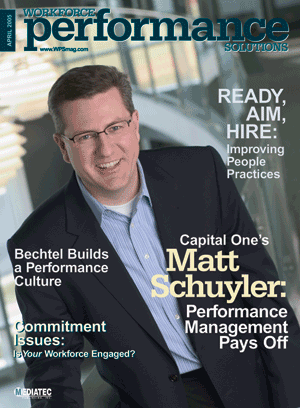 Workforce
Performance Solutions is
a new bi-monthly magazine. It is directed to top-level management, senior
human resources, and workforce and organizational development executives
whose task is to optimize the abilities of their human assets to drive
and improve the execution of enterprise strategy. This new magazine features
Harold Stolovitch as a regular contributor with a column entitled "Human
Performance." Here
is a taste of Harold's second column, "Incentives and Workplace Performance:"
Workforce
Performance Solutions is
a new bi-monthly magazine. It is directed to top-level management, senior
human resources, and workforce and organizational development executives
whose task is to optimize the abilities of their human assets to drive
and improve the execution of enterprise strategy. This new magazine features
Harold Stolovitch as a regular contributor with a column entitled "Human
Performance." Here
is a taste of Harold's second column, "Incentives and Workplace Performance:"
Some HR professionals swear by incentives; others, at them. In the United States alone, organizations spend almost $120 billion annually on work-related incentive programs. Are they getting their money’s worth?
Purveyors of incentive systems are wildly enthusiastic about using such tangibles as gifts and travel. But some researchers claim that tangible incentives destroy personal interest in work. Others conclude that organizations should not offer incentives for performance that might normally be achieved without them. Some have found that they work in specific cases with dramatic results.
To read the rest of this article, click here. For more information on Workplace Performance Solutions, visit their Website at www.wpsmag.com. You may qualify for a free issue or subscription. If you have suggestions for Harold to include in his column, please email him at hstolovitch@hsa-lps.com.

From time to time,
we come across interesting articles that we feel are important to share
with others. Our Guest Author Series features these articles by various
professional colleagues. The sixth in our series is by Erica Groschler,
Andrea Shalinsky and Linda Waddell. Erica Groschler runs her own consulting
practice, TPS Consulting and has over 13 years experience specializing
in training development, organizational development and performance improvement
for a range of industries across North America. Erica worked closely with
HSA, serving as their Director of Western North America for over five
years and learned many project management tricks of the trade from Harold
and Erica. She lives in Vancouver, B.C, is a past president of the local
ISPI chapter and can be reached at ericag@telus.net.
Andrea Shalinsky, Principal of Peak Performance and Learning Solutions
has over 10 years experience helping organizations with training and performance
improvement initiatives. Andrea has excellent leadership and people skills
and has a proven track record at successfully keeping her clients and
team members satisfied throughout the duration of her projects. Having
worked for HSA for several years, Andrea continues to apply the invaluable
lessons she learned from Harold, Erica and the Management Team. She resides
in Vancouver and can be reached at shalinsky@telus.net.
Linda Waddell manages her own successful consulting practice, TecKnowledg-e
Learning, Inc (www.tecknowledg-elearning.com).
She has over 25 years experience managing and designing creative and innovative
solutions for national and international clients and is the author of
several articles on e-learning. Linda resides in Vancouver and can be
reached at lin.waddell@shaw.ca.
Project Management Survival:
How Not to Get Voted Off the Island
By Erica Groschler, Andrea Shalinsky & Linda Waddell
 Picture
this: big raindrops are careening off palm trees, soaking you to the skin.
You shiver and are miserable because the roof is leaking. The fins of
very large sharks are visibly circling the "Project Management Survival"
island…and you can't help but ask yourself…how did I get here?
Picture
this: big raindrops are careening off palm trees, soaking you to the skin.
You shiver and are miserable because the roof is leaking. The fins of
very large sharks are visibly circling the "Project Management Survival"
island…and you can't help but ask yourself…how did I get here?
This is often our experience managing what we initially believe to be "simple" performance projects. Typically, as we delve more deeply into our projects, we soon realize they are far more complex than we'd anticipated. Once again, we are challenged by the myriad elements to handle, such as: frequently changing expectations, "fluid" budgets, shifting priorities, idiosyncratic team members, unclear communication, and unforeseen constraints, to name a few. Sound familiar?
Complete with torches, bandanas and a room packed with tribal teams, we had the pleasure of presenting our session Project Management Survival: How Not to Get Voted Off the Island at this year's International Society for Performance Improvement's (ISPI) annual International Conference in Vancouver, BC. We were fortunate to have Harold Stolovitch kick off the session. Participants munched on gummy worms and engaged in lively discussions while they worked with their tribes on a simulated project. They were tasked with:
- identifying project challenges,
- identifying associated risks, and
- developing strategies to overcome these risks.
The hypothetical case with which they were presented was based on a large blended learning project. It simulated in a synthesized way many of the HPT projects we have faced. (The names were changed to protect the innocent!) Just as in the television show Survivor, surprises in the form of "Tree Mail" arrived soon after each tribe began working as a team through the case. The Tree Mail presented the twists and turns of real performance projects. Needless to say, in light of new "Tree Mail" information, some tribes returned to the drawing board to start over.
Our presentation was based on two HPT principles:
- Systems View project management, which considers that a wide range of elements (such as those we mentioned above) are intimately interlinked. A change in one generally affects many others (e.g., a change in budget will directly affect the priorities, timelines, resources and perhaps even character of the project). Every project has its share of sudden or unexpected events or decisions. In the case of our presentation, these were delivered through the dreaded Tree Mail!
- Partnership and collaboration with clients and stakeholders. This helps to keep the torch burning and to not get voted off the Project Management Island. It is essential to work collaboratively with our clients and stakeholders to ensure the highest level of client satisfaction.
Aha!
The session soon took on a life of its own. Participants quickly entered into the spirit of the simulation role-play. They worked hard, laughed and seriously attempted to remain on the island by making sound project management decisions. What "ahas" did participants experience during our presentation? Here are a couple of key ones:
- All principles of sound project management apply whether your project is large (like the blended solution participants worked through) or small. The key to success is to ensure that you create detailed statements of work and assess, plan for and manage all risks. Risk is part of any and all projects.
- Although participants asked themselves early on, "Why did we stay on the Project Management Island if it had so many risks and challenges," they quickly discovered that the opportunities for growth and learning were tremendous. Why stay then? For the excitement, the learning, the team synergy (especially if you are working with talented team members) and…the money. In our simulated case, it was highly lucrative. Participants had an opportunity to work with a diverse and talented team across North America. While the frustrations were often high, the ability to succeed was due to the innovation and dedication of the project team.
Ahas for the Team That Put This Session Together
What about the time and effort in preparing a presentation for an international conference? Was it worth all the hard work? Would we do it again? The answer in both cases is a resounding "Yes!" A great deal of fun and learning happens when preparing for the delivery of this kind of presentation. From the proposal to the costumes and the theme, to writing the actual content, we enjoyed the camaraderie, glasses of chardonnay, and frequent laughter. In the process, we developed and tested a project management tool for ourselves and to share with others. We piloted our presentation with our local Vancouver ISPI Chapter, which provided us with valuable feedback. Our goal was to create an interactive workshop where participants learned, had an enjoyable experience and walked away with a useful performance tool. As reflected by our evaluations, we succeeded on all accounts. And we just may return next year with an Encore presentation!
Final note
When the sharks are
circling your Project Island and the coconuts fall like rain, remember
our project management checklist and get yourself onto even terrain! For
a copy of the Project Management Checklist, visit www.tecknowledg-elearning.com/nss-folder/articles/.
Do you have an article you would like us to consider including in our Guest Author Series? If so, please contact Erica Keeps at ekeeps@hsa-lps.com.

 Harold
Stolovitch will be presenting at ISPI's Instructional Systems Fall Conference
on September 21, 2005. Click here
to view HSA's Events Calendar to learn where and when Harold will be speaking
as well as to read session descriptions.
Harold
Stolovitch will be presenting at ISPI's Instructional Systems Fall Conference
on September 21, 2005. Click here
to view HSA's Events Calendar to learn where and when Harold will be speaking
as well as to read session descriptions.
Due to popular demand, Harold will be presenting at ASTD's Telling Ain't Training Mini-Conference from October 20 - 21 in Atlanta, GA. For more information, click here. Can't make the conference? Click here to buy the book.

 Do
you have any burning human performance technology questions? Visit the
Ask Harold section of HSA's Website
and ask your questions for Harold Stolovitch to answer. Here is a recent
submission that might intrigue you:
Do
you have any burning human performance technology questions? Visit the
Ask Harold section of HSA's Website
and ask your questions for Harold Stolovitch to answer. Here is a recent
submission that might intrigue you:
I'm working on a performance improvement project and just finished the cause analysis. The gaps I found fall mostly under trust issues and open communication. Should I concentrate on the examples and factors of why that trust is not there or should I state that lack of trust is the reason they are having these gaps? Also, when looking at the Behavioral Engineering Model, where would lack of trust fall under? Should it go under information or capacity?
To read the response, visit Ask Harold. To ask your own question, just click on the crystal ball above, fill out the form and click submit.

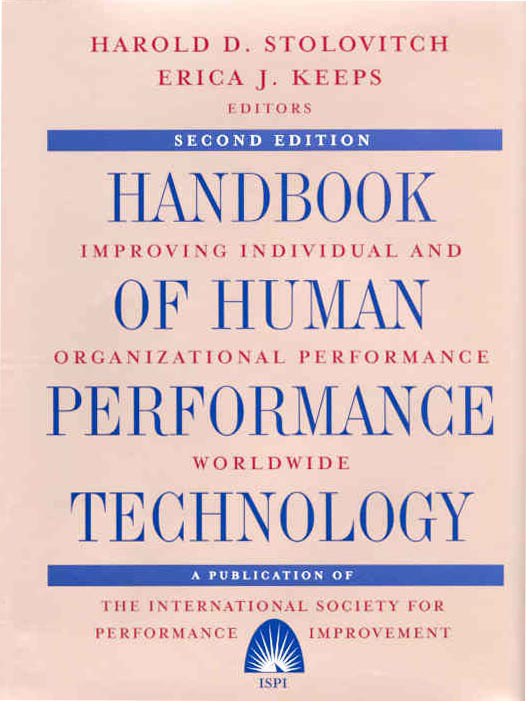
Click on any of the covers below for more information or to buy copies of our books.


The runner and the drama queen wish everyone a fun summer!For more information on HSA, visit our Website
at www.hsa-lps.com, email us at info@hsa-lps.com
or call us toll free at (888) 834-9928.If you have any questions or comments, please feel free to contact Samantha Greenhill, Publications and Communications Specialist, at sgreenhill@hsa-lps.com.

To unsubscribe from this Newswire, please reply to this email and put the word UNSUBSCRIBE in the subject line.
© Copyright 2005 Harold D. Stolovitch & Erica J. Keeps