

By Harold D. Stolovitch & Erica J. Keeps
hstolovitch@hsa-lps.com & ekeeps@hsa-lps.com
 At
school you may have had weekly tests and then a final exam. In a courtroom,
we are familiar with the lawyers "examining" and "cross-examining"
the witnesses, probing for weaknesses in their stories. In fact, the whole
concept of exams has become quite terrifying. No wonder so many people
experience stress if they feel they are going to participate in an exam.
Often those who take the exam feel as if it is not their skill and knowledge
that is being scrutinized, but they themselves. It is as if their own
worth is being examined and brought into question. There's not much difference
for some people between the statements "You failed the exam"
and "You're a failure!" Incidentally, that perception is not
restricted to low performers. A large number of high performers feel tremendous
anxiety as well.
At
school you may have had weekly tests and then a final exam. In a courtroom,
we are familiar with the lawyers "examining" and "cross-examining"
the witnesses, probing for weaknesses in their stories. In fact, the whole
concept of exams has become quite terrifying. No wonder so many people
experience stress if they feel they are going to participate in an exam.
Often those who take the exam feel as if it is not their skill and knowledge
that is being scrutinized, but they themselves. It is as if their own
worth is being examined and brought into question. There's not much difference
for some people between the statements "You failed the exam"
and "You're a failure!" Incidentally, that perception is not
restricted to low performers. A large number of high performers feel tremendous
anxiety as well.
Many people confuse testing in a natural, positive, educational manner with bad exam experiences and, therefore, erect barriers to an important learning activity. We define testing as an opportunity to verify whether or not the learner has attained the pre-specified objective. If yes, the learner must receive information either naturally by succeeding with the task or from the trainer/training in the form of a message - "Correct;" "You've done it;" "Perfect score." If the learner has not met the performance objective, then this is an opportunity to identify where the difficulty lies and provide supportive, useful feedback with the possibility of retesting until the learner has succeeded in achieving the performance objective requirements.
We train adult workers so that they will be able to perform in ways both they and the organization value. Training is by no means an end. It is a way to achieve organizationally desirable work performance outcomes by building required skills and knowledge. Our training should be designed to lead the affected adult learners simply, naturally and directly from where they are to where they and the organization believe they should be.
To accomplish this, we analyze our learners to determine the current levels of their skill and knowledge. We specify the desired state. Then we build our training as a path that leads them from "there" to "here." Our performance objectives are the milestones. Our tests are checkpoints that perfectly match the objectives. This whole approach is often called criterion-referenced instruction - that is, instruction solidly anchored to the criteria for successful job accomplishment. The testing part is called criterion-referenced testing. It is the natural means for ensuring that the learner has met the objective at the appropriate standard of performance.
If the training were for delicatessen counter workers to be able to slice a bagel into equal halves with smooth surfaces, then the test would be for them to demonstrate this performance. If they missed something (unequal halves or rough surfaces), then they would receive feedback and be tested again until they succeeded.
Please note that tests to verify objective attainment are not necessarily exams. They could take the form of practice exercises, self-checks, team challenges or en route tests. In a formal setting they could become exams. What is key is that testing checks for performance objective success. In the learning environment, it should be done as naturally as possible to decrease stress that may inhibit performance. If exams are required, we recommend that you engage learners in sufficient test practice to replace their anxiety with confidence.
What follows is an example from our experience that illustrates the point.
Sample Scenario: I've Been Working on the Railroad
Obviously, this can be a stressful time for railway personnel as they approach their exams. For the railway, it's important to keep the locomotive engineers and conductors on the job. When we became involved at one railway, we found that the exams were mostly content-centered rather than performance-based and were more a set of reading tests than true verification of competency. Working with management, unions and governement examiners, we revised the exams so that they were more closely matched with what the engineers and conductors actually did on the job. We broke all the subjects down into major job tasks. We created lots of practice that tied closely to the tasks using clearly defined performance objectives. The practice exercises matched the objectives and the practice tests matched the exercises. So closely was it all interwoven that training time radically decreased and the exam success ratio shot way up. Best of all, the operational personnel found the testing easier although it was more job application focused and contained 30 percent more test questions. When
we used the old exam to test the engineers and conductors three
months after they were recertified, many of them couldn't attain
the overall 85 percent passing grade. With the new approach, more
than 90 percent scored 85 percent and higher three months and
even six months after recertification. As one longtime railroader
put it: "Before, I hated the exams and couldn't sleep for
days. With the new approach, my exam felt like all the practice
tests I did on my own and in the class. No sweat!" |
 All
railway personnel who operate trains must go through a certification
ritual every three years. Their work requires them to take exams
on nine different subjects related to every aspect of handling
a train. It includes a variety of content from inspecting airbrakes
to marshalling trains to reading signals to knowing specific regulations
for different weather and track conditions. If they don't pass
all exams with a minimum of 85 percent, they don't get their cards
renewed. No card, no work.
All
railway personnel who operate trains must go through a certification
ritual every three years. Their work requires them to take exams
on nine different subjects related to every aspect of handling
a train. It includes a variety of content from inspecting airbrakes
to marshalling trains to reading signals to knowing specific regulations
for different weather and track conditions. If they don't pass
all exams with a minimum of 85 percent, they don't get their cards
renewed. No card, no work.This
article is an excerpt from Harold Stolovitch and Erica Keeps' award-winning,
best-selling book, Telling Ain't Training. For
a more detailed discussion of
testing vs. exams, click here
to order a copy of the book.

 Questions
abound in the learning and performance world. Here is one we were recently
asked along with our answer. We welcome additional questions as well as
comments and reactions to our response.
Questions
abound in the learning and performance world. Here is one we were recently
asked along with our answer. We welcome additional questions as well as
comments and reactions to our response.
What is the difference between efficiency and effectiveness?
Efficiency is productivity with minimum waste. It is the achievement of maximal results with the least amount of resources and energy expended. An example would be your attainment of a goal in the least costly manner with the least amount of your energy and resources used. Highly skilled persons usually perform tasks that achieve high results with far less effort than novices. Watch an expert swimmer do laps in a pool. She or he seems to glide effortlessly back and forth. Caloric expenditure is minimal compared to the novice who splashes around and is soon exhausted doing far fewer laps.
Effectiveness is achieving the desired result from the expenditure of resources and effort. Think of a medication for an ailment. If it is effective, it will cure the ailment. An aspirin for the common headache is a simple example. Taking a cough medicine for the headache would be ineffective.
In learning and performance, we strive to create interventions that exhibit the two characteristics of effectiveness and efficiency. Suppose a person had to be able to dial the correct number for a given emergency, but the number varied depending on the nature of the emergency. You could drill the numbers into the person's head and make him or her repeat these until a perfect result was achieved. It would be effective, but not necessarily efficient. Another way might be to provide a telephone with clearly labelled emergency numbers on it and spend a few minutes training the person on how to press the appropriate buttons. Hence, for a given emergency, the person would simply press the right button. Much more efficient than all the drill and practice and the possibility of error over time.
Remember, determine what will be effective first. Then determine the most efficient means for getting there. Focus effectiveness on results and efficiency on the means for attaining them.
Do
you have any burning human performance technology questions?
Visit the Ask Harold section of HSA's Website and ask your questions for
Harold Stolovitch to answer. Just
click on the crystal ball above,
fill out the form and click submit.

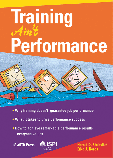
Harold Stolovitch and Erica Keeps, co-authors of Training
Ain't Performance,
recently shared their views on ROI analysis, best practices, human performance
improvement theory and practice, leaders and pioneers in the field, and
professional institution with ASTD Links In Practice Field Editor
for Management Development, George Hall. Here are a couple of questions
they responded to:
"In your book you comment, 'In the workplace, despite the explicit emphasis on bottom-line results, there is still an enormous confusion between behaviors - or activities - and valued accomplishments, between knowing and achieving, and between training and performance.' Why all of the confusion? What impact does this have? What do you recommend?"
"Can
you briefly trace the historical development of HPI theory and practice
from its origins to state-of-the art? What is your greatest hope for the
field? What is your greatest fear?"
To read the answers to these questions as well as much more, click here to read both parts of this interview. For more information or to order Training Ain't Performance, click here.

From time to time, we come across interesting articles that we feel are important to share with others. Our Guest Author Series will feature these articles by various professional colleagues. The fourth in our series is by Jerry Linnins, CPT, Manager of Learning, Performance and Quality for Blue Shield of California. He is a a 25-year veteran of the U.S. Coast Guard and has worked as a consultant, trainer, learning and development manager, and performance improvement specialist with military, federal and state government agencies, and the healthcare field. He was a contributor to the 2000 ASTD Training and Development Yearbook and presented at the 1994 ISPI Conference. Jerry resides in Suisun City, CA and loves to network with fellow CPTs. He may be reached by email at jerry.linnins@blueshieldca.com.
Calling Their Baby Ugly
By Jerry Linnins
Sooner or later in your consulting career, you will find yourself in the awkward position of having to listen to a client proudly describe what you are sure is the worst conceived performance intervention you have ever heard. Imagine, it has taken you months to get them this excited about anything. You listen in horror as they lay out a plan of action that goes directly against everything you have been trying to teach them. Your carefully selected mountain of articles, books, and periodicals seems to have had no impact (if they were read at all).
Now, unless you are ethically-challenged, you feel the overwhelming need to either burst out laughing, have a good cry, or scream at them that their idea - their baby - is UGLY!
This is why and where you earn the "big bucks." How you respond can make or break your reputation, your relationship with the client, and impact the likelihood that the issue at hand can be resolved successfully. It is probably the biggest challenge you will ever face as a consultant because you have as much at stake as the client.
What do you do?
The first thing you need is a plan. It is important that you have thought through how you will respond when experiencing this situation. This is crucial since many times the "ugly baby" is shown to you at chance meetings, without advance warning, or at the worst possible time for you. Clients just seem to have a knack for knowing when you have your physical, emotional, and/or mental guard down. Having a plan in advance lessens the likelihood that you will blurt out a "gut" reaction and thereby scuttle months of work.
Be honest, be tactful, and then:
- Celebrate the client's effort.
- Clarify the content of the "ugly baby."
- Construct a context for your feedback.
- Communicate your concerns constructively.
- Commit to collaborate on solutions.
Celebrate the Client's Effort
This is especially important. The client has made an effort and it is important to recognize their attempt to analyze their problem, develop a solution, and to take responsibility for their own issues of concern. Here you are not only interested in the content of their idea or plan but in the process they used to generate it. Both may need to be addressed in your feedback.
Clarify the Content of the "Ugly Baby"
A really effective way to give yourself some time to think on your feet and ensure that what you heard was, in fact, what the client meant, is to ask for clarification. Sometimes, just the process of repeating an idea or steps in a plan verbally triggers one's own evaluation and feedback processes to kick in. Gaps in logic, data, or organization many times become self-evident.
As a facilitator, I've used this tool often and have even named it "The Idiot Technique" (I'm really good at it!). I simply ask the client or group to repeat back to me what they meant to ensure I captured (in my head or on a flipchart) what they really intended. This step of clarifying usually yields important new nuances of meaning that I failed to capture initially. Listen for emotion, "shouldda's," and historical baggage. All can be tacit drivers of actions not always in everyone's best interest.
Construct a Context for Your Feedback
This is probably the area that gets most of us into trouble. We assume certain roles (listener, advisor, counselor, "parent," disciplinarian, etc.) that the client may or may not intend for us to take. To minimize the danger of this, ask the client what role they want you to assume. Is this idea a "straw man" and the client wants you to play devil's advocate, or is it a hard, personal decision that they want you to just listen to them as they talk it through? Knowing the difference can mean keeping or losing a client. Setting a context for your feedback should include declaring the role you intend to speak from.
Communicate Your Concerns Constructively
Even if you disagree with everything the client has said/decided, it is important that your feedback be constructive. It should "build up" the client, your relationship, the plan or idea, and strengthen the foundation upon which you and the client will develop a better product. Another helpful technique is to provide the client with three "Plus" (positive) things about their idea and three "Delta" items (areas where their idea can be improved). The idea is that your feedback should be balanced, specific, in context, and aligned with the client's need - not necessarily their expectation, their want, or what someone else has suggested. Your feedback should make their idea/plan better!
Commit to Collaborate
One of the most helpful things we can do as consultants is to let our clients know they are not alone. Two heads are better than one. The old saying, "They don't care how much you know till they know how much you care," applies here. Letting the client know you are committed to helping them achieve their goals is often the best preparation for getting a client to listen. I often remind clients that they first need to get something down on paper and then work to get it right! Treat the idea as simply words on paper - words that can be changed, improved upon, and that are separate from you (the consultant) and them (the clients).
A Thought to Grow On
In today's demanding world of work, we require good ideas, engaged individuals and teams, and work environments that support quality thinking more than ever. Ideas are fragile things. They must be nourished and not tossed around carelessly. They need space to grow and develop.
Remember, even if
it is ugly, it is still their "baby."
Do you have an article that you would like us to consider including in our Guest Author Series? If so, please contact Erica Keeps at ekeeps@hsa-lps.com.

Harold Stolovitch and Erica Keeps have launched the first two toolkits in the Pfeiffer Learning and Performance Toolkit Series. Leading organizations all over the world are already designing, managing and evaluating successful training, learning and performance projects using the tools previously only available in their workshops. Now these essential tools are at an arm's reach. These indispensable toolkits coach readers through the entire process.
Engineering Effective Learning Toolkit
Click on the above book cover to read an excerpt and/or to purchase this publication.
Engineering Effective Learning Toolkit is a hands-on resource that offers a systematic, 14-step approach for designing and evaluating successful training, learning and performance projects. The accompanying CD-ROM includes easily reproducible and customizable charts and job aids to help you accomplish each step in the instructional design process.
Front-End Analysis and Return on Investment Toolkit
Click on the above book cover to read an excerpt and/or to purchase this publication.
Front-End Analysis and Return on Investment Toolkit is a comprehensive collection of guidelines, job aids, rich examples and tips that give readers the information needed to create performance interventions that will deliver the desired results. It also includes a robust "plug and play" CD-ROM that helps users actually derive a bottom-line ROI number. By using this vital resource you will be able to analyze training requests on the front end, measure worth and ROI in learning and performance on the back end, as well as much more.

 Harold
Stolovitch will be presenting at the 2005 Training Conference & Expo
from February 26 to 28 in New Orleans, LA and ASTD's Central Illinois
Chapter on April 5 in Bloomington, IL.
Click here
to view HSA's Events Calendar to learn where and when Harold will be speaking
as well as to read session descriptions.
Harold
Stolovitch will be presenting at the 2005 Training Conference & Expo
from February 26 to 28 in New Orleans, LA and ASTD's Central Illinois
Chapter on April 5 in Bloomington, IL.
Click here
to view HSA's Events Calendar to learn where and when Harold will be speaking
as well as to read session descriptions.
For more information on HSA, visit our Website at
www.hsa-lps.com, email us at info@hsa-lps.com or
call us toll free at (888) 834-9928.
If you have any questions or comments, please feel free to contact Samantha Greenhill, Publications and Communications Specialist, at sgreenhill@hsa-lps.com.

To unsubscribe from this Newswire, please reply to this email and put the word UNSUBSCRIBE in the subject line.
© Copyright 2005 Harold D. Stolovitch & Erica J. Keeps