
Welcome to the sixth edition of the HSA e-Xpress. We feel it's important to keep you up-to-date on what's going on in our field as well as within HSA. This issue features articles on key ingredients for learning, the link between front-end analysis and return on investment as well as much more.

By Harold D. Stolovitch & Erica J. Keeps
hstolovitch@hsa-lps.com & ekeeps@hsa-lps.com
 When
all the dust settles, what are the key ingredients for learning? Cognitive
psychology research suggests that three major factors influence how much
and how well we learn: ability, prior
knowledge, and motivation.
We'll examine each of these in detail in this article.
When
all the dust settles, what are the key ingredients for learning? Cognitive
psychology research suggests that three major factors influence how much
and how well we learn: ability, prior
knowledge, and motivation.
We'll examine each of these in detail in this article.
Ability
The capacity with which we were born that enables us to acquire new skills and knowledge varies among individuals. Just like height or musculature, we arrive on the scene with a certain mental (or learning) potential. It may be unfair but some of us are born taller, slimmer, more physically attractive, or able to learn more quickly than others. This general learning ability is the intellectual capacity with which we are genetically endowed. It strongly influences our overall capacity to learn. Note the word "general." With greater general ability, we grasp more quickly, comprehend more easily, and recall more efficiently than others do. We seem to get it faster and play it back or even enhance it better than those not as intellectually able. Obviously, like musculature, the way in which intellectual ability is fostered and trained can seriously affect how well one's cerebral capabilities grow and develop. As trainers, we need to note that learners vary in their ability to learn. We have to be aware of the differences in ability and compensate for those who do not learn as rapidly as others. We also have to keep the more generally able learners constantly stimulated and challenged to maintain their focus.
Although we possess general intellectual ability, we also are endowed with specific abilities at our birth. An ear for music, a golden voice, an athletic agility, or an artistic talent are extremely valuable specific learning abilities that are more important than general intellectual capability in certain instances. The innate, specific abilities of Michael Jordan in basketball, Barbra Streisand in music, and Pablo Picasso in art has played enormous roles in allowing those "learners" to achieve far beyond others who may have received the same "training."
Although we can't alter a person's ability, we can observe and detect his or her strengths and weaknesses. As a result, we can adapt the learning system by taking the following measures:
- Adjusting the amount of time for learning.
- Providing more practice for those who require it.
- Simplifying and breaking learning into smaller chunks for those who are experiencing learning difficulties.
- Providing additional support for those who need it.
- Including activities with greater challenge for those who learn more quickly.
Those are only a few ways of compensating for differences in learning ability. The key is to observe and acknowledge such variations and make suitable modifications to the instruction, whether live, online, or from a book.
Prior Knowledge
General and specific abilities greatly influence learning, but how much a person already knows about what he or she is being taught also strongly affects learning. A brilliant philosopher or mathematician may not learn as well as a less intellectually gifted carpenter when receiving some new piece of instruction about carpentry. Prior knowledge helps the learner acquire additional knowledge or skills more rapidly. So the more you know about something, the easier it is to acquire additional knowledge and skills in that subject.
If learners are missing prerequisite knowledge and skills, we can make adjustments to these gaps in the following ways:
- Creating prelearning session materials to close the gaps.
- Building special supplementary learning events prior to or concurrent with the learning sessions.
- Creating peer tutoring pairs and teams to provide mutual support for overcoming gaps.
- Providing overviews and summaries of prerequisite content in outline or summary form.
- Directing learners to online sites that can fill knowledge or skill gaps.
That's only a starter list. Offering sources of knowledge or resources for acquiring prerequisite skills can help bring learners up to speed quickly.
Motivation
We all have seen the power of high motivation - the desire to achieve something. We also have seen the reverse: those who don't care, have no drive, or seem to lack interest in learning rarely achieve proficiency in new knowledge and skills. We often talk about motivation and its importance, but what is it?
Motivation is affected
by three major factors - value, confidence, and mood.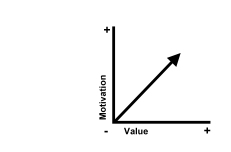
- Value. The more we value something, the more motivated we are about it. In the figure to the right, we have placed motivation on the vertical axis and value on the horizontal. Notice that as the learner attributes a greater value to what is to be learned, motivation increases. If you value being seen as someone who knows opera or football, you will become more inspired (that is, motivated) to learn about it. The higher the value attributed to what is to be learned, the greater the motivation.
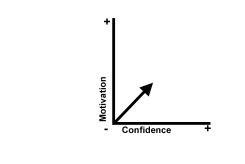
- Confidence. If you feel totally inept in your ability to learn something, how motivated are you to try? The answer, of course, is unmotivated. Low confidence in learning is strongly correlated with low motivation. As the confidence of the learner increases, so does the motivation, as illustrated to the right.
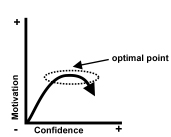 Overconfidence,
however, leads to a decline in motivation. If the learner feels that "this
is so easy, I don't even need to try," motivation plummets, as in
the graph to the left.
Overconfidence,
however, leads to a decline in motivation. If the learner feels that "this
is so easy, I don't even need to try," motivation plummets, as in
the graph to the left.
The optimal point of motivation is where the learner has enough confidence to feel she or he can succeed, but not so much that the incentive to learn declines. This high point of motivation is one of challenge ("I have to work at it to succeed") and security ("but if I do work at it, I know I can succeed").
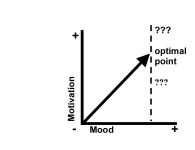 Mood.
We all know that if we're not in the mood, our motivation to learn goes
down. Personal feelings affect our mood as does the atmosphere of the
learning and working environment. A positive learning/working environment
tends to improve a person's mood and, hence, his or her motivation,
as illustrated in the graph to the right. But a frivolous or manic mood
might have bizarre and unpredictable effects on motivation. A positive
mood is one in which you are open and optimistic without being flighty
or euphoric.
Mood.
We all know that if we're not in the mood, our motivation to learn goes
down. Personal feelings affect our mood as does the atmosphere of the
learning and working environment. A positive learning/working environment
tends to improve a person's mood and, hence, his or her motivation,
as illustrated in the graph to the right. But a frivolous or manic mood
might have bizarre and unpredictable effects on motivation. A positive
mood is one in which you are open and optimistic without being flighty
or euphoric.
Based on the three major factors that affect motivation, we can overcome deficiencies in the following ways:
- Enhancing the value of what is to be learned. Show the learners what's in it for them. Provide examples of benefits. Show them admired role models valuing what is to be learned. The more the learners perceive personal value in what they are learning, the more motivated they will become.
- Adjusting the learners' confidence levels with respect to the learning content. Be supportive to build their confidence that they can learn but provide sufficient challenge so that they don't become overconfident about it.
- Creating a positive learning atmosphere and work climate. The more open and optimistic the context you build, the more open and positive the learners will be, and that leads to greater motivation…and to learning.
In Summary
Keep in mind that all learners are different. Whether as a group in a classroom, as a team at the workplace, or individually through a manual or via computer in real time or asynchronously, they come to us with widely differing characteristics. Training, in its broadest sense, is a compensation for what each of our learners lack. Just imagine what our job would be if all of our learners came to us with elevated general and specific learning abilities, vast prior knowledge, and tremendous motivation. Talented, knowledgeable, motivated learners only require learning resources and useful feedback. The less they possess of each of the ingredients, the more we trainers have to work to compensate for what they lack. Yes, that's our job - compensating for what our learners don't have, managing the learning context, and providing feedback and rewards for success.
This article is based on Harold Stolovitch's and Erica Keeps' award-winning, best-selling book, Telling Ain't Training. To learn more or to order a copy, click here.
To
learn more about HSA workshops on Training Delivery
and/or Instructional Design, click here.

By Erica J. Keeps & Harold D. Stolovitch
ekeeps@hsa-lps.com & hstolovitch@hsa-lps.com

Front-end analysis (FEA), a term coined by Dr. Joe Harless (1970), often
raises both eyebrows and questions. What does it mean? What does it do?
In simple language, it is the set of activities in which you engage at
the beginning of a performance improvement project. It is somewhat like
needs assessment, needs analysis, performance analysis, gap analysis and
other similarly named activities. We prefer FEA for its chronological
simplicity. It's the analysis you engage in right at the "front-end."
You can apply it proactively. In other words, it is a methodology and
set of tools you can use as you identify workplace performance deficiencies
or improvement opportunities. You can also engage in FEA reactively -
as a result of a request for training or some other form of human performance
improvement intervention.
ROI, as it relates to performance improvement professionals, stands for return on investment in learning and performance. In order for organizations to succeed in their ventures, they carefully examine the external world - the marketplace - for opportunities, leveragable events and resources while factoring in the myriad pressures that exist. Once they identify these, they set their goals, objectives and strategies and then turn inwardly to ensure that their internal systems can help them achieve the results they have set for themselves. A key internal factor is human performance. To achieve success, the people involved must exhibit certain behaviors, which result in desired accomplishments. Through verification of the behaviors and accomplishments, you can determine the degree to which these are aligned with business goals and objectives and intervene, as appropriate, to optimize them.
The examination of business requirements, human performance requirements and the selection of suitable interventions to achieve valued behaviors and accomplishments is the domain of FEA. However, an essential ingredient is the cost of the interventions compared to the value they provide to the organization. This is where worth analysis and ROI calculations become necessary - beforehand, during the planning stage, to estimate worth and the potential for ROI. Then, afterward, at the control stage, to demonstrate what the true ROI was.
FEA and ROI are closely intertwined. FEA helps identify performance gaps, factors affecting them and potential interventions or solutions for eliminating each one. It concludes with a recommended selection of the optimal combination (or basket) of interventions based on appropriateness, economics, feasibility and acceptability, both organizationally and in terms of the individual performers. Worth and ROI calculations help determine what the organization can expect, in hard cash, for its efforts and investment, as well as what the actual return has been.
|
There
is little point conducting an ROI study in learning and performance
projects if no FEA was conducted and the interventions were not applied on the basis of this analysis. |
Calculating ROI after the fact for an intuitively selected intervention offers limited utility. The main purpose of ROI calculations is to verify the extent to which selected interventions achieved valued results beyond their costs so that this can be replicated in future projects.
The link between FEA and ROI is clear. FEA helps you systematically analyze and determine what the performance gaps are and what you have to do to eliminate them to achieve your business goals. Worth and ROI calculations allow you to verify whether or not the elimination of the performance gaps will be (beforehand) or was (after the fact) worth it and what you achieved or can expect concretely in dollars and cents compared to costs. The results of the FEA provide you with the path to follow while those of the worth and ROI calculations tell you what you will get/got for your money. Both are necessary activities for the performance improvement professional.
Concerned or Unsure About How to Conduct FEA or Calculate ROI?
In April 2004, Pfeiffer launches our latest product in its Learning & Performance Toolkit Series. The Front-End Analysis and Return on Investment Toolkit provides systematic methods and tools that guide you through a complete FEA and both worth and ROI calculations. The FEA & ROI Toolkit has been created to meet your needs by accomplishing two goals: using the toolkit will allow you to systematically analyze a performance need or gap in order to select the appropriate interventions for closing the gap and to ensure that the investment in energy and costs in closing the gap is worth it. Its overall objective is for you, with the help and guidance that the toolkit provides, to be able to analyze and document a request for training or performance support from a performance perspective and prescribe suitable interventions. You will also be able to calculate the worth and ROI of your selected interventions.
FEA and ROI can appear complex and intimidating. Have no fear. The Front-End Analysis and Return on Investment Toolkit has been born out of two concerns: a need for structured, understandable, easy-to-use tools and guidelines, and solid, credible outcomes that meaningfully influence decision-makers. To learn how you can purchase a copy of the Toolkit, click here.
HSA
offers a one-day FEA & ROI workshop in-house at a client site or through
professional organization chapters. If you are interested in learning
more
about the FEA & ROI Workshop, click here.


Harold Stolovitch recently presented HSA's Telling Ain't Training and Training Ain't Performance workshops to nearly 100 members of ISPI Golden Circle in Des Moines, Iowa. The event, which was co-sponsored by Drake University, was well attended and received.
Both the Sydney and Melbourne Australia ISPI chapters offered HSA's Front-End Analysis and Return on Investment workshop in September 2003 to enthusiastic participants.
The ISPI Silicon Valley and ASTD Los Angeles chapters both plan on offering HSA workshops in 2004.
Consider
an HSA workshop as a fundraiser and/or membership booster for your local
ISPI or ASTD chapter. For more information, contact Erica Keeps at
ekeeps@hsa-lps.com.

 With
just a few applications remaining to be processed, more than 800 individuals
from the United States and around the world took advantage of the Grandparenting
provision and received the Certified Performance Technologist (CPT) designation.
Erica Keeps and Harold Stolovitch have both been certified. Many HSA associates
are also on the CPT list. HSA enthusiastically supports the CPT initiative
with its associates and clients. To view a full list of CPTs, visit www.certifiedpt.org.
With
just a few applications remaining to be processed, more than 800 individuals
from the United States and around the world took advantage of the Grandparenting
provision and received the Certified Performance Technologist (CPT) designation.
Erica Keeps and Harold Stolovitch have both been certified. Many HSA associates
are also on the CPT list. HSA enthusiastically supports the CPT initiative
with its associates and clients. To view a full list of CPTs, visit www.certifiedpt.org.
Certification represents a major step in the evolution of performance technology as a true profession. There are a number of organizations now using the Standards of Performance Technology to select and develop their performance improvement professionals. Some have gone so far as to imbed the CPT certification process into their personnel development plan. And, several colleges and universities have adopted the Standards as the underlying structure for their performance improvement curricula.
In meeting standards and criteria as performance improvement practitioners, CPTs demonstate an understanding of what it takes to produce desired, measurable results through a systematic and reproducible process. The certification credential enables Certified Performance Technologists to distinguish themselves in the marketplace to employers and clients.
The current CPT application has two provisions. The first is for those with three or more years experience in the field of performance improvement or related fields such as instructional design, organizational development and human resource management. Applicants under this provision must demonstrate their use of the first four Standards three times and the remaining six Standards twice. Those applicants with more than 10 years of experience may apply under a new provision that allows them to qualify for the designation by documenting their experience and demonstrating how their work exemplified use of the 10 Standards. The cost for applying under either provision is the same, $895 for ISPI members and affiliated member groups and $1,195 for non-members.
For
those interested in joining ISPI's growing list of CPTs,
more information can be found at www.certifiedpt.org.

Engineering Effective Learning Toolkit
Click on the above book cover to read an excerpt and/or to purchase this publication.
Filled with illustrative, real-world examples, Engineering Effective Learning Toolkit by Harold D. Stolovitch and Erica J. Keeps offers a systematic, step-by-step approach for designing, managing and evaluating successful training, learning and performance projects. This indispensable toolkit is a personal "coach" you can refer to on an "as-needed" basis or use to complete a training project from start to finish. It's your toolkit for successful instructional design!
HSA now offers a cost-effective alternative to conducting our instructional design workshops at your site. Owners of the Engineering Effective Learning Toolkit can now be tutored by phone and/or online on how to apply our processes to their real world projects. For more information, contact Erica Keeps at ekeeps@hsa-lps.com.

 Harold Stolovitch will be presenting at a number of events over the next
couple of months including Training 2004 in February in Atlanta and ISPI
International in April in Tampa. Click here
to view HSA's Events Calendar to learn where and when he'll be as well
as read session descriptions.
Harold Stolovitch will be presenting at a number of events over the next
couple of months including Training 2004 in February in Atlanta and ISPI
International in April in Tampa. Click here
to view HSA's Events Calendar to learn where and when he'll be as well
as read session descriptions.

 Do
you have any burning human performance technology questions? Visit the
Ask Harold section of HSA's Website
and ask your questions for Harold Stolovitch to answer. Here is a recent
submission that might intrigue you:
Do
you have any burning human performance technology questions? Visit the
Ask Harold section of HSA's Website
and ask your questions for Harold Stolovitch to answer. Here is a recent
submission that might intrigue you:
Can HPT be applied in an educational organization?
To read the response, visit Ask Harold. To ask your own question, just click on the crystal ball above, fill out the form and click submit.
For more information on HSA, visit our Website at www.hsa-lps.com, email us at info@hsa-lps.com or call us toll free at (888) 834-9928.
If you have any questions or comments, please feel free to contact Samantha Greenhill, Publications and Communications Specialist, at sgreenhill@hsa-lps.com.

To unsubscribe from this Newswire, please reply to this email and put the word UNSUBSCRIBE in the subject line.
© Copyright 2004 Harold D. Stolovitch & Erica J. Keeps