
By Harold D. Stolovitch, PhD, CPT, and Erica J. Keeps, CPT
hstolovitch@hsa-lps.com & ekeeps@hsa-lps.com
Doing a proper task analysis is a critical step in the performance-based instructional design process. If done correctly, it can increase the probability of creating instruction that is relevant to both the job and the learner. This article provides tips to help you conduct task analyses. It focuses on the most widely used type of task analysis, the hierarchical task analysis.
Task Analysis Tips
Here are some tips to help you conduct successful task analyses aimed at building job-relevant capability:
- Create a compatible task analysis team that includes SMEs who really know how to do the job. Whether you are developing a learning program to diagnose technical breakdowns, plan a sales campaign, demonstrate a new product, or analyze a profit-and-loss sheet, this principle remains the same. Also identify other experts who can review and verify what you and your team produce.
- Your main job is to be the learner's advocate. Repeatedly ask the question: "What must the learner be able to do?" Whether it is name features of the XYZ system, describe the functioning of a pressure gauge or extract a molar, the result must be observable and/or measurable. The best term to use is verifiable.
- Sometimes, you are given SMEs who don't possess all of the information you need to complete an accurate task analysis. They may not be sufficiently knowledgeable or experienced in the content area, or the content may be new and evolving. Establish right up front that they should inform you of their uncertainties. Ask them to identify persons or materials that can provide missing pieces. If there is no single source of correct information - especially true in the case of evolving systems and technologies - create hypotheses and note these as such for later verification. Have other experts review what you have produced. Build consensus on what is most probably correct. Keep in mind that you can always return to your task analysis and modify it as new information becomes available.


There are many task analysis methods. The one we use most often is called hierarchical task analysis. It works well in most cases to help break down the overall task into its simpler elements.
Suggestions for Conducting Hierarchical Task Analyses
- As much as possible, work with "real" experts.
- Starting at the top, ask your experts, "What does the learner have to be able to do to complete this task?" Think big. Force thinking to the highest level below the overall main task. In a hierarchy you are moving from the "monarch" to the "prince and princess" level and then on downward.
- The "thinking backward" approach to hierarchical task analysis is the toughest part of task analysis. It definitely gets better with practice.
- Continue breaking subtasks down. Stop each time you arrive at the entry level of the majority of your learners. Then move on to the next subtask until the task analysis is complete.
- The entry level of the learners is never stable. You will have to arbitrarily set what the level is based on the majority of the learners. This means that, for some learners, you can eventually allow them to "test out" of simpler parts of the learning system. This can be a great savings in time and money for your organization. You avoid unnecessary training. For less experienced learners, you may have to require prerequisite knowledge and experience. You may also create prerequisite learning materials and events that bring them up to the specified learning entry level.
Throughout the process, keep your eye firmly fixed on what the learner-performer will have to do back on the job.
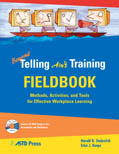
This article is an excerpt from Harold Stolovitch and Erica Keeps' bestseller,
Beyond Telling Ain't Training Fieldbook.
Interested in learning more? Click here
to order a copy of the book.

 We
were recently contacted by a Telling Ain't
Training reader who let us know how he is using the book
in his organization:
We
were recently contacted by a Telling Ain't
Training reader who let us know how he is using the book
in his organization:
I
attended the Telling Ain't Training Conference in Virginia in November
of 2007. I work for the Katy Independent School District as the Technology
Training Supervisor. I am always looking for new and creative ways to
make my training fun and memorable. I find that many times technology
falls into the "training" mode. The participants do not take
anything with them when they leave other that what was shown in class.
True, they may be able to "do" what was taught in the session,
however, I am never satisfied unless I know that the learning continues
into their "real word" (life back in the cubicle or in the classroom).
I am not tooting my own horn here by any means but I was trying to figure
out why all of my course evaluations tend to be higher than the other
trainers.... Well, I have figured out why.
Several reasons:
- I connect with my participants. I find out who each of them is as they enter the room or by a group introduction.
- By connecting with the learner first, it helps me figure out the direction I need to take the class so that I can give them examples from their world.
- I try to tap into each learner's way of seeing the world. This can be a bit difficult since it is technology, however I can do it most of the time.
- I have created activities in all of my sessions that participants apply and use before they leave the class, no matter how short or long the session is. In fact, I have made most sessions a little longer to include activities. (I did not do this as much before I went to the conference.)
I am sure I do
other things as well, however, these four points came to mind as I was
reading your book again. In fact, I believe in Telling Ain't Training
so much that I have ordered five copies and am going to do a book study
with the five trainers we have in our district.
I am at the TCEA (Texas Computer Education Association) conference this
week and I had time today to sit and focus on your book again. (I called
this my Ken Retreat). I am so excited to get the opportunity to share
the information from your book with my trainers. I feel they will benefit
and be brought up to the next level.
Thanks for your expertise and if you are ever in Katy, Texas look me up!
- Kenyon
Boswell, Technology Training Supervisor, Katy Independent School District
Click here to read more Telling Ain't Training reviews and ideas for putting Telling Ain't Training to work in your organization.
Loved
Telling Ain't Training? Go the next step and bring Telling Ain't
Training live and in-house to your organization! Click here
to learn more about
Telling Ain't Training workshops.

 Talent
Management is a monthly magazine directed to top-level management,
senior human resources and workforce and organizational development executives
whose task is to optimize the abilities of their human assets to drive
and improve the execution of enterprise strategy.
Talent
Management is a monthly magazine directed to top-level management,
senior human resources and workforce and organizational development executives
whose task is to optimize the abilities of their human assets to drive
and improve the execution of enterprise strategy.
Harold Stolovitch is the "Human Performance" columnist for Talent Management magazine. You can read his latest article, "Changing Attitudes " by visiting page 10 of the April 2010 digtial edition at http://www.nxtbook.com/nxtbooks/mediatec/tm0410/#/12. For more information on Talent Management, visit their Website at www.talentmgt.com. If there are any topics that you would like Harold to address in his column, please email him at hstolovitch@hsa-lps.com.

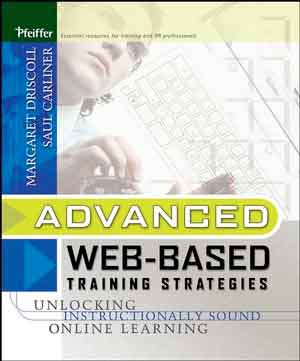 Our
Guest Author Series features articles by various professional colleagues.
The latest in our series is an excerpt from Advanced
web-based training: Adapting real world strategies in your online learning
by co-author Dr. Saul Carliner, CPT. Dr. Carliner is an associate professor
with a graduate program in educational technology at Concordia University
in Montreal, Canada specializing in the design of learning and communication
materials for the workplace, and the management of groups that create
these materials. He can be reached at saul.carliner@education.concordia.ca.
Our
Guest Author Series features articles by various professional colleagues.
The latest in our series is an excerpt from Advanced
web-based training: Adapting real world strategies in your online learning
by co-author Dr. Saul Carliner, CPT. Dr. Carliner is an associate professor
with a graduate program in educational technology at Concordia University
in Montreal, Canada specializing in the design of learning and communication
materials for the workplace, and the management of groups that create
these materials. He can be reached at saul.carliner@education.concordia.ca.
A Portfolio of Techniques for Using Stories and Cases in E-Learning Programs
By Dr. Saul Carliner
In presenting teaching content, storytelling is an umbrella term for a variety of techniques that use plot and character as a means of engaging learners with the material and presenting that material to learners in a contextualized way.
Three of the most popular storytelling techniques include personal accounts, simulations, and case studies. The following sections describe them and suggest how you might weave them into e-learning programs.
Personal
Accounts
A personal account is an experience report. It describes a situation in
which an individual applied the content taught in the course to his or
her personal life. Two wide uses of personal accounts are to motivate
learners with an interesting story or to describe successful application
of the learning concepts in the real world.
Usually, the personal account comes from an instructor or one of the learners in the class. In the classroom, most personal accounts are a form of "war story." Fortunately, in most of these stories, the front lines are business environments, not actual battle fields in war. In virtual classrooms, instructors use war stories much as they do in classroom courses.
In asynchronous courses with videotaped lectures, war stories continue to appear. What's more common in asynchronous courses, however, are different types of personal accounts, such as accounts from individuals and organizations. This difference often results from the additional time available for researching asynchronous online courses (as compared to classroom and virtual courses) and the absence of the instructor's persona from asynchronous courses.
A third wide use of personal accounts is as a means of teaching, especially advanced technical material. For example, in a study of the education of hardware service representatives for a major manufacturer, researchers found that advanced learners learned more from sharing war stories around the water cooler than they did from formal classes. The reason that these advanced learners learned more around the water cooler is that they wanted to learn how to handle specific problems. Someone might ask, "How do you handle such-and-such?" Someone else would respond, "I had a problem like that. First we tried A, but it didn't work because of thus-and-so. So we tried this second approach and it worked." Through the story, not only do people learn how to fix the problem, they also learn the reasoning underlying the approach.
Simulations
Simulations are educational activities that place learners in a fictional
situation that reproduces the key elements of the real one it mimics.
Within this situation, learners can act and experience the consequences
and benefits of those actions as if they were in the real world, without
any of the harsh consequences. As a result, each learner creates his or
her own story. For example, The Virtual Leader, a management simulation
course, lets learners develop principles of management by experiencing
simulated business experiences. Based on their responses, each student
experiences a unique "story" as they go through this course.
The challenge in designing such an experience is designing the debriefing,
and making sure that learners can identify their experiences, place labels
on them, and identify broader concepts that they can apply.
Case
Studies
Case studies are detailed descriptions of situations in which an organization
faces one or more crucial decisions. The cases describe the people, incidents,
and context that led up to the decision-but do not include the solution
in the materials originally given to learners. In a course, instructors
often present the case and let learners figure out how they would solve
the problem based on the information available. Later, learners discuss
their solutions and compare them with the actual solution that the organization
in the case chose.
A case is essentially a story about an organization facing a particular challenge at a particular point in time. The story can be factual or fictional. A formal case study tells a factual story about a real organization and results from formal and extensive research that involves interviews with the key players in the case and an evaluation of reports and other documentation. A fictional case study is usually made up by the instructor and, although it exhibits many of the same characteristics of a formal case study (it might even be based on a real organization), is not based on an actual organization or it does not emerge from formal and extensive research.
Case studies help learners synthesize concepts. By determining how they would solve cases, case studies provide learners with an opportunity to determine which concepts are relevant to a real-world situation, and how they apply. Just as significantly, case studies also help learners determine which concepts do not apply to a given situation, and help learners avoid the problem of the inappropriate application of principles.
Case studies are most widely used in management courses, both academic and corporate ones. For example, UNEXT, the online university, builds its business management courses around cases. Case studies are also used in other types of educational situations, including design courses (like instructional design, system design, and engineering design), training on customization, and troubleshooting, and medical education.
Excerpted
from Driscoll, M. and Carliner, S. (2005.) Advanced web-based training:
Adapting real world strategies in your online learning San Francisco:
Pfeiffer. Used with permission.

Over the last few years, we have been including articles from respected members of our field in the HSA e-Xpress's Guest Author Series. These have been very well received by our subscribers. We are looking for articles and/or book excerpts that would be of interest to our readers. If you have an article and/or book excerpt that you would like us to include in our Guest Author Series, please contact Erica Keeps at ekeeps@hsa-lps.com. Along with your article, we will include your bio, company name and contact information including a link to your Website. You are welcome to submit a previously published article and we will be sure to include a reprinted with permission statement. Articles should be about 750 - 1,000 words.

 Here's
where Harold Stolovitch will be presenting in the near future:
Here's
where Harold Stolovitch will be presenting in the near future:
- ASTD Telling Ain't Training and More... Conference - September 28 & 29, 2010 in Denver, CO
- ASTD Telling Ain't Training and More... Conference - October 12 & 13, 2010 in Arlington, VA
- ASTD Telling Ain't Training and More... Conference - October 14 & 15, 2010 in Atlanta, GA
Click here to view HSA's Events Calendar to learn where and when Harold will be speaking as well as to read session descriptions.

 Do
you have any burning Human Performance Technology questions? Visit the
Ask Harold section of HSA's Website
and ask your questions for Harold Stolovitch to answer. Here is a recent
submission that might intrigue you:
Do
you have any burning Human Performance Technology questions? Visit the
Ask Harold section of HSA's Website
and ask your questions for Harold Stolovitch to answer. Here is a recent
submission that might intrigue you:
A
colleague of mine and I are working on the challenges new hires face in
organizations. We were wondering when is it worthwhile to hire a star
performer? And, the flip side of that, if you are a star performer, should
you stay put versus move to other positions and/or organizations?
To read
the response, visit Ask
Harold. To ask your own question, just click on the crystal
ball at left, fill out the form and click on submit.

Click on any of the covers below for more information or to purchase copies of our books and learning aids.




For more information on HSA, visit our Website
at www.hsa-lps.com, email us at info@hsa-lps.com
or call us toll free at 1-888-834-9928.If you have any questions or comments, please feel free to contact Samantha Greenhill, Publications and Communications Specialist, at sgreenhill@hsa-lps.com.

© Copyright 2010 Harold D. Stolovitch & Erica J. Keeps